Look Again: The 30-Second Mirror Habit That Changes How You See Yourself

Photo: Wilfredor, CC BY-SA 4.0, via Wikimedia Commons
Be honest: when was the last time you actually looked at yourself?
Not checked. Not scanned. Not the quick glide across the bathroom mirror while your brain runs a silent audit — the under-eye situation, the breakout, the way your face looks tired today, the hair that isn't cooperating. I mean really looked. The way you'd look at a friend who walked into the room.
For most of us, the answer is: never, or close to it. The mirror has become a machine for finding faults, and we run the scan on autopilot, multiple times a day, absorbing a quiet drip of criticism we'd never say out loud to another human being.
There's a fix for this, and it takes thirty seconds.
The Scan Problem
Here's the thing about how most of us use mirrors: we're not seeing ourselves. We're running a threat-detection pass. Eyes go straight to the 'problem areas' — wherever those got assigned in your personal map, usually somewhere in adolescence and never updated since — and the rest of the reflection barely registers.
Psychologists have a concept that helps explain why this hurts: self-perception theory, the idea that we learn who we are partly by observing our own behavior. If your mirror behavior is a daily hunt for flaws, you're teaching yourself, over and over, that the default way to see your face is critically. It becomes a habit loop. Wake up, scan, wince, move on.
And here's the kicker — the criticism isn't even accurate. Research on self-perception consistently shows we're worse at judging our own appearance than strangers are at judging it. We zoom in on details nobody else sees. We compare today's face to a highlight-reel version of ourselves from years ago. We mistake tired for ugly, normal for flawed.
The mirror isn't the problem. The scan is.
What Curiosity Does That Criticism Can't
So here's the practice. It's almost embarrassingly simple, which is exactly why it works.
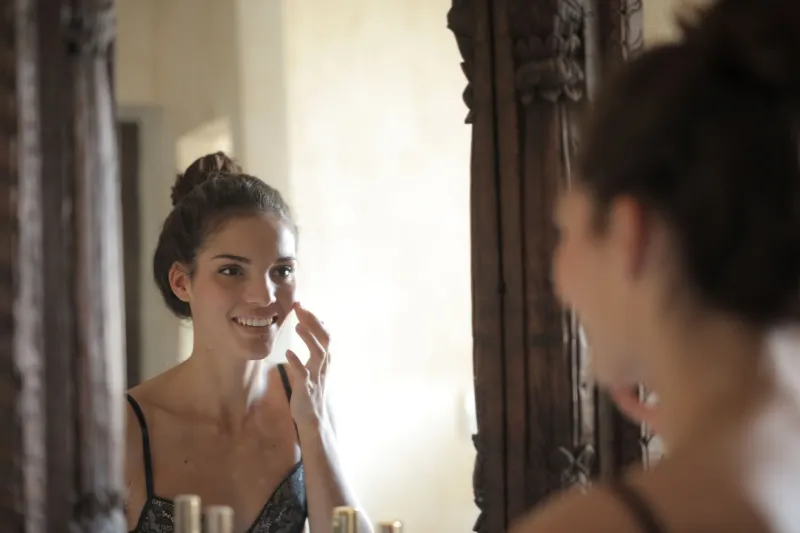
Once a day — morning works, but any consistent time is fine — stand at the mirror and look at your face for thirty seconds. Not to fix anything. Not to check. To look, the way you'd look at a photograph of someone you care about.
That's it. But the instructions matter, because the difference between this and your usual mirror moment is the difference between criticism and curiosity:
- Start neutral, not positive. You don't have to force affirmations. If 'I look beautiful' feels like a lie, skip it. The goal is just observation without verdict. 'This is my face today' is a complete sentence.
- Look at the whole. Let your eyes move across your entire face instead of locking onto the usual targets. Notice things you've never noticed — the exact color of your irises, the way one brow has a mind of its own, a freckle in a spot you forgot about.
- Soften the inner monologue. When the critic shows up — and it will, usually within the first ten seconds — notice it and come back to looking. You're not trying to silence the voice. You're just not letting it drive.
- End with one true, kind observation. Not flattery. Something factual and warm. 'My eyes look bright today.' 'I like this face.' Even 'I showed up' counts.
Thirty seconds. That's the whole practice.
Why This Actually Works
It sounds too small to matter, but the mechanism is real. Repeated exposure to your own face in a non-judgmental context is essentially exposure therapy for self-criticism. The first few days feel awkward — sometimes genuinely uncomfortable, especially if mirror avoidance has been your default. That discomfort isn't a sign it's not working. It's a sign you're interrupting a pattern.
What tends to happen over a few weeks is subtle but noticeable. The wince reflex softens. You catch your reflection in a store window and don't immediately look away. Getting ready stops feeling like an inspection and starts feeling like... just getting ready. Some people describe it as finally recognizing themselves, which sounds dramatic until you realize how rarely most of us do.
There's a confidence dividend, too — and it compounds. When you stop starting the day with a critique, you carry a different baseline into everything else. The outfit choices get bolder, because you're not dressing around a flaw you've been marinating in. The photos get easier. The video calls stop being a fight-or-flight experience.
The Moment You're Reclaiming
Think about how many mirror moments you get in a day. Bathroom, car, elevator, phone screen. Each one is a tiny fork in the road: scan and criticize, or look and acknowledge.
You don't need to win every one of those moments. You just need to win one, deliberately, every day. Thirty seconds of seeing yourself as a whole person instead of a list of defects.
The mirror has been telling you one story for a long time. It turns out you get to choose the narrator — and the kind version knows things the critic never learned.